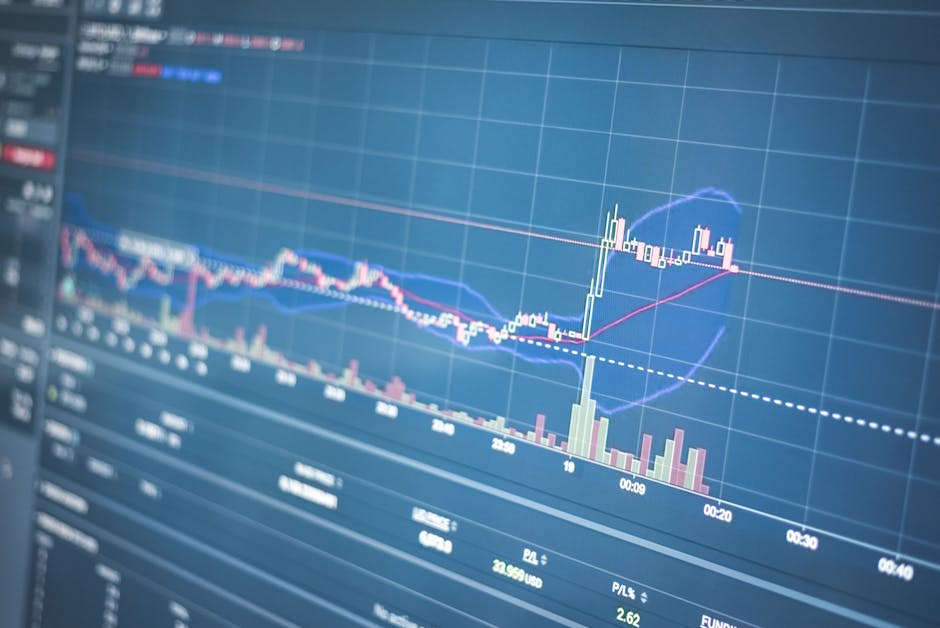
While_legacy_systems_require_manual_data_processing,_the_digital_framework_of_Instantprofitai_utiliz
Legacy Systems vs Instantprofitai: Manual Data Processing Meets Automated Algorithms

The Burden of Legacy Systems in Market Analysis
Traditional trading and financial analysis often rely on legacy systems that require manual data entry, spreadsheet calculations, and human interpretation of market signals. Analysts spend hours collecting data from multiple sources, cleaning it, and running basic calculations. This process is slow, prone to human error, and limited by the analyst’s cognitive capacity. For example, a trader using legacy methods might manually track moving averages or RSI levels across a handful of assets, but scaling this to hundreds of instruments becomes impractical. The latency between data collection and decision-making can result in missed opportunities, especially in volatile markets where prices shift within seconds.
Moreover, manual systems lack the ability to process unstructured data like news sentiment, social media trends, or real-time order flow. Analysts must rely on delayed reports or gut feelings. This creates a bottleneck: even the most skilled traders cannot compete with the speed and breadth of automated systems. The operational cost is also high-hiring teams of analysts to perform repetitive tasks reduces profit margins. For many firms, the transition to digital frameworks is no longer optional but a necessity for survival.
Common Pitfalls of Manual Processing
Errors in manual data entry, such as misplacing a decimal point or using outdated price feeds, can lead to significant financial losses. Additionally, manual systems cannot backtest strategies across historical data efficiently. A trader might spend weeks manually testing a hypothesis, while an automated system can run thousands of simulations in minutes. The human brain is also susceptible to cognitive biases like confirmation bias or recency bias, which distort objective analysis. These limitations make legacy systems increasingly obsolete in a data-driven economy.
The Digital Framework of Instantprofitai
Instantprofitai replaces manual workflows with a fully automated algorithmic engine. The platform ingests real-time market data from global exchanges, news feeds, and alternative data sources. Its algorithms apply machine learning models to identify patterns, correlations, and anomalies that humans would miss. For instance, the system can detect a sudden divergence between price action and volume, triggering an alert or executing a trade in milliseconds. This speed and accuracy are impossible to achieve manually. The core architecture is built on instantprofitai.org, which provides a scalable cloud infrastructure for processing terabytes of data daily.
The automated framework eliminates human latency and bias. Decisions are based purely on quantitative signals and predefined risk parameters. Users can customize the algorithm’s settings-such as risk tolerance, asset classes, and timeframes-without writing code. The system also performs continuous backtesting and optimization, adapting to changing market conditions. This allows traders to focus on strategy refinement rather than data collection. In contrast to legacy systems, Instantprofitai offers a transparent audit trail: every decision is logged and can be reviewed for compliance or performance analysis.
Key Components of the Algorithm
The algorithm uses a multi-layered approach: (1) data aggregation from APIs and web scraping, (2) signal generation via technical indicators and natural language processing, (3) risk scoring using volatility and liquidity metrics, and (4) execution through broker integrations. Each step is automated and parallelized. For example, sentiment analysis scans thousands of news articles per second, assigning a bullish or bearish score to each asset. This data feeds into a decision tree that filters out low-probability trades. The result is a consistent, rule-based methodology that outperforms discretionary manual trading.
Real-World Implications and User Adoption
The shift from manual to automated analysis has tangible benefits. Users of Instantprofitai report reduced time spent on research-from hours to minutes-and improved accuracy in identifying entry and exit points. The platform’s algorithms can monitor 24/7 markets, something impossible for a human. This is particularly valuable for cryptocurrency and forex traders who operate across time zones. Legacy users often face burnout from constant screen monitoring, while automated systems handle this without fatigue.
However, automation is not a set-and-forget solution. Users must still understand market fundamentals and validate the algorithm’s outputs. Instantprofitai provides educational resources and performance dashboards to help users interpret results. The key advantage is scalability: a single user can manage a portfolio that would require a team of analysts in a legacy setup. As financial markets become more complex, the gap between manual and automated methods will only widen.
FAQ:
How does Instantprofitai differ from traditional trading software?
Traditional software often requires manual input and analysis, while Instantprofitai uses automated algorithms to process data and generate signals without human intervention, reducing errors and latency.
Can I customize the algorithms in Instantprofitai?
Yes, users can adjust risk parameters, asset preferences, and timeframes through a user-friendly interface. No coding is required, allowing for personalized strategies.
Is the platform suitable for beginners?
Yes, the automated nature helps beginners avoid common mistakes. However, understanding basic market concepts is recommended to interpret the algorithm’s recommendations effectively.
What data sources does Instantprofitai use?
It aggregates data from major exchanges, news APIs, social media feeds, and economic calendars, ensuring comprehensive market coverage in real time.
How secure is the platform?
Instantprofitai uses encrypted connections and follows industry-standard security protocols. User funds are not held on the platform; trades are executed through integrated broker accounts.
Reviews
Sarah K.
I spent years doing manual chart analysis. Instantprofitai cut my research time by 80% and my win rate improved. The automation is a game-changer for busy professionals.
Marcus T.
Legacy systems were killing my productivity. Now I let the algorithms handle the heavy lifting while I focus on strategy. Highly recommend for serious traders.
Elena R.
At first I was skeptical about automation, but the backtesting features convinced me. My portfolio grew steadily without me staring at screens all day.